
.png)
Introduction
In the rapidly changing insurance landscape, speed and precision are everything. New regulations, emerging risks, and evolving customer expectations mean that insurers can no longer rely on static systems or months-long development cycles. What used to be coded deep within a policy administration system must now be updated, tested, and deployed in days or even hours.
That is why the most forward-thinking carriers are re-architecting the heart of their systems around a Business Rules Engine (BRE), a platform that separates decision logic from core applications and empowers business users to drive change directly.
What Is a Business Rules Engine (BRE)?
A Business Rules Engine is the invisible decision layer that defines how your insurance system behaves. The concept of a business rules engine centers on providing a flexible, maintainable way to manage decision logic, and understanding this concept is essential for building effective and adaptable systems.
It executes thousands of micro-decisions every second: which coverage options to display, how to price a policy, whether to approve a risk, or which rate table to apply. The definition of a rule in this context is a clear, formal statement that determines system behavior, and precise definitions are fundamental to the reliability and clarity of any rule engine.
Historically, these rules were buried deep in code. This lack of separation between business logic and application code made systems rigid and hard to maintain. Updating them meant searching through thousands of lines written years earlier, a slow and expensive process that depended entirely on IT teams. This was exactly the challenge that inspired the creation of Higson.
When Decerto’s engineers and insurance experts began building solutions for global insurers, they noticed the same pain point everywhere: rules hidden in code, duplicated across systems, and nearly impossible to trace or modify quickly. Decerto’s engineers set out to develop a new solution and implement a modern rules engine that would address these issues. Higson was designed to solve that, to make decision logic transparent, editable, and scalable. Its structure, along with the use of modular functions and objects, ensures that rules are organized, maintainable, and easy to extend.
Today, Higson powers decision automation for major insurers like Warta, InterRisk, and others, turning static rulebooks into agile, business-driven systems. Higson’s design prioritizes simplicity and a straightforward user experience, making it accessible to business users. Rules are defined and managed using a domain-specific language, which allows for clear, flexible, and efficient rule implementation.
Insurance System Requirements
Modern insurance systems face increasing demands for agility, compliance, and the ability to manage complex business logic. Rule engines have become essential in meeting these insurance system requirements, providing a strong foundation for executing business rules that govern everything from underwriting to claims processing. In recent years, the focus has shifted toward using rule engines to streamline and automate insurance processes, allowing businesses to define, maintain, and modify rules with greater efficiency.
A robust rule engine enables insurers to adapt quickly to regulatory requirements and shifting market conditions, ensuring that business rules remain current and effective. This flexibility is crucial for managing complex business logic, as insurers must frequently update their rules to reflect new products, changing customer needs, and evolving risks. By centralizing rule management, insurance companies can create, test, and deploy new logic rapidly, improving both operational efficiency and customer service.
Ultimately, leveraging rule engines for business process management empowers insurance organizations to execute business rules with precision, maintain compliance, and deliver innovative services that meet the expectations of today’s customers.
How It Works
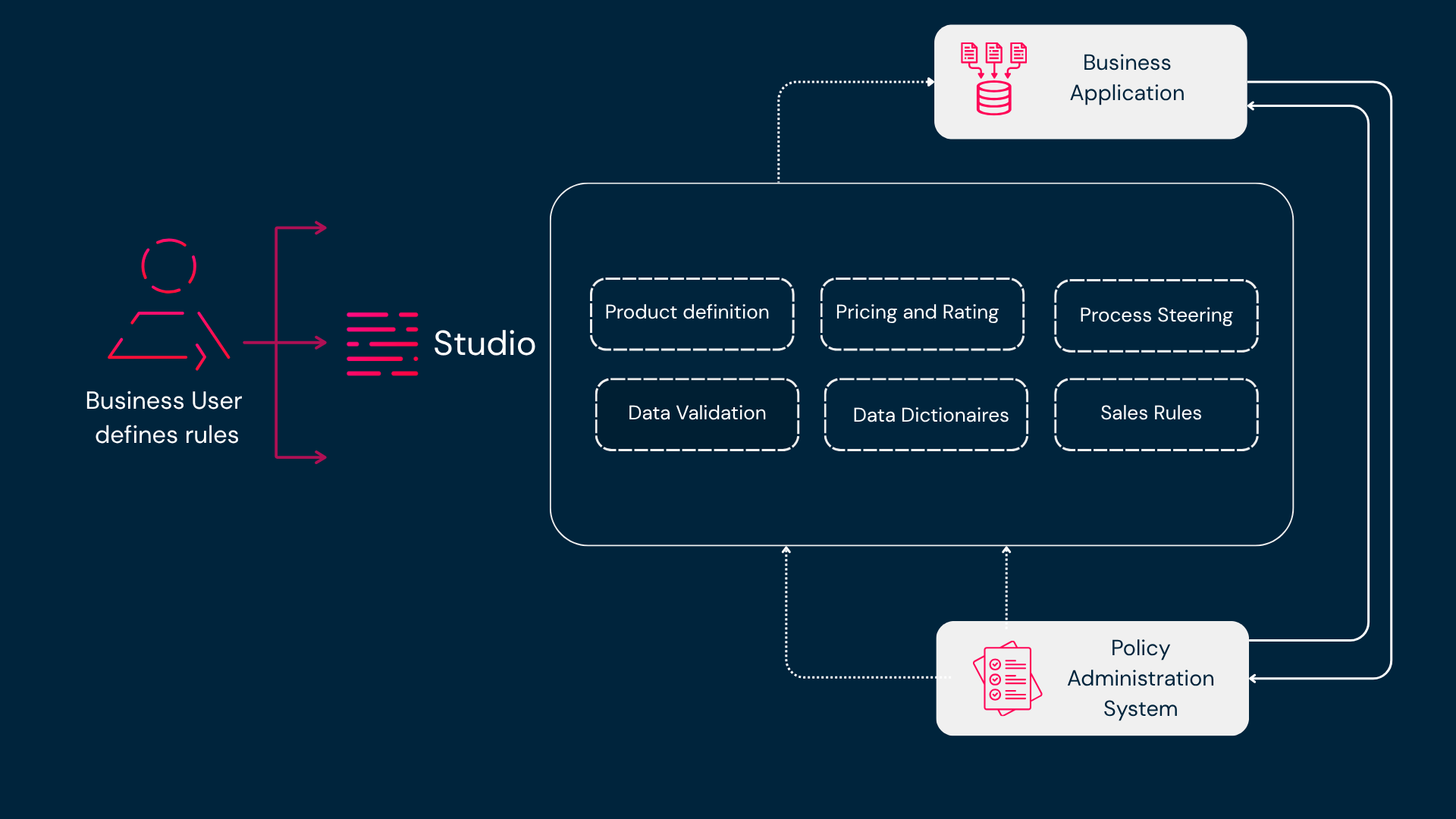
A Business Rules Engine like Higson acts as a bridge between business teams and the core insurance infrastructure. Through an intuitive studio interface, business users can define and modify logic that governs product definitions, pricing, process steering, data validation, and sales rules. These configurations are then executed automatically across connected systems such as business applications and policy administration platforms. This architecture allows insurers to implement changes instantly, maintain consistency across all environments, and ensure that every decision reflects current business strategy and compliance requirements.
Why Insurers Should Adopt a Business Rules Engine
Below are five reasons why modern insurance platforms should be built on a rules engine foundation.
1. Empowering the Business
Traditional systems make every product or rate change an IT project. A BRE reverses that logic. It gives actuaries, analysts, and product owners direct control over rules through an intuitive interface rather than source code.
In Higson, a business user can adjust underwriting thresholds, modify pricing logic, or launch a product variant without waiting for a release cycle. This hands-on approach allows users to practice and prototype rule changes directly, improving understanding and maintainability. This shift removes the bottleneck between business and technology, enabling faster innovation and closer alignment with market needs.
2. Faster Time to Market
Speed is now a competitive advantage. Whether it is adapting to new regulations or responding to competitor pricing, insurers that act faster win. A BRE enables just that by isolating decision logic from core systems.
With Higson, new tariff or coverage rules can be implemented, tested, and released in hours instead of weeks. Before deployment, it is essential to thoroughly test and evaluate rules to ensure their accuracy and compliance with regulatory requirements. This agility is critical for carriers operating across multiple regions and regulatory frameworks, especially in markets like the US or EU where compliance demands constant adaptation.
3. Transparency, Auditability, and Version Control
In insurance, every decision must be explainable not only to customers but also to regulators. A Business Rules Engine ensures complete visibility into what decision was made, when, and why. It also ensures that the answer or conclusion reached by the system can be traced and justified through formal logical processes.
Higson offers full versioning, letting teams track every change and restore previous configurations when needed. Each rule, table, or function has a clear audit trail. This is invaluable for compliance, governance, and internal control, providing the confidence that every outcome can be justified and reproduced. The value produced by the rules engine, such as risk scores or customer classifications—can also be audited and validated.
4. Integration with AI and Predictive Models
The latest generation of rules engines, like Higson 4.2, extends beyond rule execution. Modern rules engines support integrations with a wide range of external systems and platforms, enabling seamless connectivity with development ecosystems and business process management tools. They can integrate with AI and predictive models, blending business expertise with data-driven insight.
Through built-in ONNX model integration, Higson allows insurers to call trained machine learning models, for example for risk scoring, fraud detection, or customer segmentation, directly from within rule logic. That means predictive intelligence becomes a native part of decision-making without adding architectural complexity. Managing runtime performance is crucial when executing complex models and rules together, ensuring efficient and scalable decision processes.
This combination of human-defined logic and machine-learned insight represents the next stage of decision support in insurance: explainable, flexible, and real-time.
5. Simplifying Complexity
Insurance is one of the most complex data ecosystems in business. Policies, products, and pricing differ across markets, channels, and customer segments. A BRE simplifies this complexity by centralizing logic in one place while allowing contextual variation. It can also simplify complex expressions or dependencies, making them more manageable and efficient to maintain.
In Higson, rules can be grouped by product, channel, or region, enabling teams to maintain clarity even across thousands of dependencies. Creating a domain-specific subset of rules further improves maintainability and clarity. When change is needed, it happens in one place and is immediately reflected everywhere else.
Security and Access Control
Security and access control are fundamental to the integrity of any rule engine, especially in highly regulated industries like finance and insurance. A comprehensive security framework ensures that only authorized personnel can access, modify, or execute business rules, protecting sensitive business logic from unauthorized changes and potential risks.
Rule engines employ advanced techniques such as forward chaining and backward chaining to control the execution of rules, ensuring that only the appropriate logic is triggered in the right context. The Rete algorithm, a cornerstone of efficient rule processing, further enhances security by optimizing how rules are evaluated and executed, reducing the risk of unintended outcomes.
Implementing robust access control measures—such as role-based permissions, encryption, and detailed audit trails—enables businesses to maintain strict oversight of their rule engines. This not only safeguards the system against internal and external threats but also ensures compliance with industry regulations. By prioritizing security and access control, insurance organizations can confidently manage their rule engines, knowing that their business processes and sensitive data are protected at every stage of execution.
Data Management and Analytics
Effective data management and analytics are at the heart of leveraging rule engines to their full potential in insurance. By integrating data from multiple sources, businesses can execute business rules that are informed by real-time insights, enabling smarter and more responsive decision-making.
A modern rule engine serves as a powerful tool for managing complex business logic, allowing organizations to create a data-driven decision-making framework. This approach not only streamlines processes but also enables continuous improvement, as analytics reveal trends, patterns, and opportunities for optimization. By analyzing data, insurers can refine their rules to better manage risks, enhance customer experiences, and respond swiftly to market changes.
Furthermore, the combination of rule engines with advanced analytics and machine learning empowers businesses to identify emerging risks and capitalize on new opportunities. This integration transforms the rule engine from a static component into a dynamic engine for innovation, driving growth and ensuring that insurance organizations remain competitive in a rapidly evolving landscape. With robust data management and analytics, insurers can manage, execute, and optimize complex business logic with confidence and agility.
Case Study: InterRisk and the IRON Platform
InterRisk TU SA Vienna Insurance Group embarked on a major modernization effort to replace fragmented systems with a unified, flexible platform called the IRON (InterRisk Online Network).
At the heart of this transformation lies Higson, which became the backbone of product configuration and decision management. By moving decision logic into Higson, InterRisk achieved:
- Faster product configuration as business users can define and modify rules without developer support
- Centralized decision logic eliminating duplication and inconsistencies across systems
- Improved time to market as new product variants can be introduced and validated through comprehensive testing tools, ensuring reliability and correctness
- Transparent governance as all rule changes are versioned and auditable
The result was a platform that not only accelerated product launches but also created a culture of collaboration between IT and business, which is exactly what a Business Rules Engine is meant to achieve.
The IRON platform leverages advanced tools for rule management and supports efficient business operations, enabling robust and dependable decision-making processes.
Conclusion
The insurance industry is built on decisions about risk, pricing, eligibility, and compliance. As those decisions grow more complex, insurers must adopt systems that can handle them with speed, transparency, and intelligence.
A Business Rules Engine provides exactly that foundation. It transforms decision-making from a coding exercise into a business capability, bridging human expertise with automation.
With solutions like Higson, insurers can innovate faster, maintain control, and ensure that every decision, from pricing to claims, is consistent, explainable, and aligned with company strategy.
In an industry where every rule counts, a rules engine is no longer optional. It is the new core of modern insurance systems.

Take Full Control of Your Product Logic
We provide fee Proof Of Concept, so you can see how Higson can work with your individual business logic.


.png)
.png)
.png)